

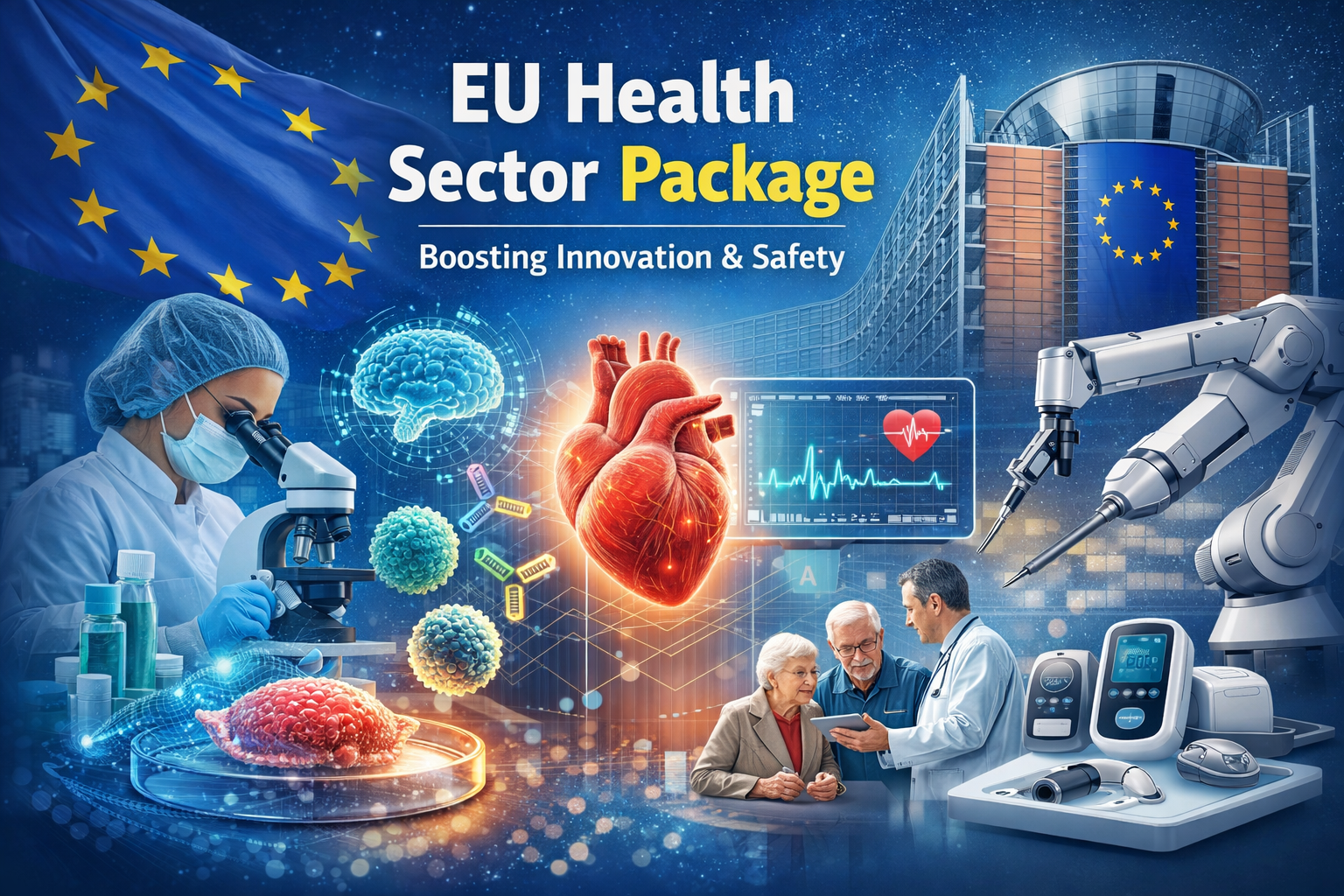
In December 2025, the European Commission has unveiled a new EU Health Sector Package, marking a significant step towards a more innovative, resilient and competitive European health ecosystem.
The package combines legislative proposals and policy initiatives designed to accelerate health innovation, strengthen patient safety, and address Europe’s most pressing health challenges: notably biotechnology, medical devices reform, and cardiovascular disease prevention.
1. The European Biotech Act: accelerating Innovation and Competitiveness
At the heart of the package lies the European Biotech Act presented as a proposal for a regulation aimed at boosting Europe’s biotechnology sector and reinforcing the EU’s global competitiveness.
The Biotech Act seeks to:
-
Stimulate biotechnology innovation across the EU by creating a more supportive regulatory environment.
-
Speed up clinical trials and regulatory approvals, reducing time-to-market for breakthrough therapies.
-
Support AI-driven health solutions, particularly in diagnostics, treatment development, and personalised medicine.
-
Strengthen local production capacities, improving strategic autonomy and supply chain resilience.
A strong focus is placed on the integration of artificial intelligence (AI) into health biotechnology, recognising its transformative role in research, development, and patient care.
Examples of innovative health technologies highlighted within this policy context include:
-
CAR-T cell therapies, where immune cells are engineered to recognise and destroy cancer cells, offering rapid tumour elimination and long-term remission potential.
-
Monoclonal antibodies, lab-produced antibodies that support the immune system in targeting harmful or faulty cells, with applications ranging from oncology to neurological diseases.
-
Bioengineered stem-cell heart patches, which deliver healing stem cells directly to damaged heart tissue, promoting repair and reducing scarring.
2. Safe Hearts Plan: a Strategic Response to Cardiovascular Disease
Complementing the legislative proposals, the Commission has adopted the Safe Hearts Plan (Safe Hearts Plan), presented as a Communication outlining a coordinated EU approach to cardiovascular health.
Cardiovascular diseases remain the leading cause of death in the EU. The Safe Hearts Plan addresses this challenge by:
-
Improving prevention, early detection, and treatment of cardiovascular conditions.
-
Leveraging digital tools and AI, including data-driven screening and remote monitoring.
-
Reducing health inequalities between regions and population groups through targeted interventions.
Implementation will be carried out in close cooperation with Member States, reinforcing alignment between EU-level policy objectives and national health systems.
The Safe Hearts plan earmarks more than EUR 200 million for further research and innovation.
3. Medical Devices Reform: Faster Access, Stronger Safety
The Health Sector Package also includes a proposal for a regulation on medical devices, responding to long-standing concerns from industry and healthcare providers.
Key objectives of the reform include:
-
Simplifying regulatory procedures and reducing administrative burdens.
-
Accelerating market access for safe and effective medical devices.
-
Enhancing digitalisation and coordination with the European Medicines Agency (EMA)
-
Maintaining high patient safety standards while strengthening EU industrial competitiveness.
This reform aims to ensure that innovation reaches patients faster, without compromising safety or quality.
Next steps
The legislative proposals under the Health Sector Package will now be examined by the European Parliament and the Council as part of the ordinary legislative procedure.
In parallel, implementation of the Safe Hearts Plan will begin in cooperation with Member States.

 English (UK)
  Français